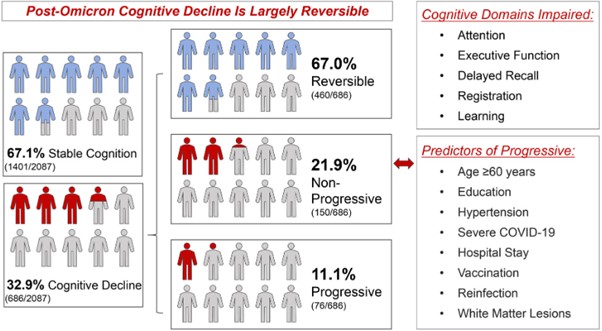
Most hospitalized survivors maintain or regain cognitive function, while older and reinfected patients may face progressive decline
WUHAN, HUBEI, CHINA, August 27, 2026 /EINPresswire.com/ — More than two-thirds of hospitalized COVID-19 survivors maintained stable cognition 2 years after Omicron infection, while one in five experienced reversible decline. Researchers report that only 10.8% developed irreversible cognitive decline, including 3.6% with progressive decline. Older age, reinfection, severe illness, hypertension, longer hospitalization, and white matter lesions increased the risk, while education and vaccination were protective. Findings highlight potential for cognitive recovery, supporting monitoring of patients at higher risk of progressive decline.
Cognitive problems, often described as “brain fog,” are a recognized feature of long COVID, affecting attention, memory, and executive function. Earlier SARS-CoV-2 variants, including the original strain, Alpha and Delta, were associated with persistent cognitive deficits. However, the Omicron variant caused less severe disease, leaving uncertainty about whether cognitive decline would persist, improve, or progress, particularly in older adults.
Addressing this challenge, a research team led by Professor Yan Wan and Professor Bo Hu from the Department of Neurology, Union Hospital, Tongji Medical College, Huazhong University of Science and Technology, China, followed 3,419 patients hospitalized with COVID-19 during the Omicron-predominant period from December 2022 to March 2023 across nine hospitals in China. Cognitive function was assessed by telephone at 6 months and 2 years after the infection using the Telephone Interview of Cognitive Status-40 and the Informant Questionnaire on Cognitive Decline in the Elderly. Among 2,087 survivors who completed both assessments, researchers classified cognitive trajectories as stable, reversible decline, non-progressive decline, or progressive decline. The study was published online on July 16, 2026, in the journal Neuroprotection.
Two years after discharge, 67.1% of participants maintained stable cognitive function, while 22.0% experienced reversible cognitive decline. Irreversible decline affected 10.8%, comprising 7.2% with non-progressive decline and 3.6% with progressive decline. Among participants with reversible decline, TICS-40 scores increased by 3 points from 21.00 at 6 months to 24.00 at 2 years. Improvement occurred in attention and calculation, delayed recall, registration, learning ability, and executive function. By contrast, the progressive group showed a 4-point TICS-40 decrease, from 17.00 to 13.00, with deterioration particularly affecting attention and calculation, delayed recall, and registration.
“Our findings indicate that cognitive decline after Omicron infection is not necessarily permanent,” says Prof. Wan. “The substantial recovery observed over 2 years is encouraging, but the persistence of deficits in a vulnerable minority shows why patients at higher risk should not be overlooked.” Age 60 years or older was linked to more than fourfold higher odds of progressive decline, while each additional infection increased the odds more than twofold. Severe COVID-19, hypertension, longer hospitalization, and white matter lesions were also independently associated with progressive decline. In contrast, each additional year of education and a higher number of vaccination doses were protective.
These findings could help clinicians target follow-up and rehabilitation resources. Healthcare providers could consider age, infection history, disease severity, vascular health and brain imaging when deciding who needs closer monitoring. The domain-specific results may also inform rehabilitation approaches targeting attention, memory, learning and executive function. For patients and families, evidence that many cognitive changes improve may reduce anxiety while encouraging follow-up for persistent symptoms.
“Our results support a more targeted approach to long-term cognitive care after COVID-19,” says Prof. Hu. “Identifying high-risk patients early could help guide monitoring and rehabilitation, while broader prevention measures such as vaccination may reduce the likelihood of progressive decline.” The findings may encourage collaboration among neurologists, rehabilitation specialists, geriatricians and researchers. Future studies could build on these results with longer follow-up and comprehensive, in-person neuropsychological assessments to clarify how cognitive trajectories evolve beyond 2 years.
Overall, the study shows that post-Omicron cognitive decline is largely reversible, but recovery is not universal. The findings point toward a balanced long-term strategy: reassure patients that improvement is common, while identifying older adults and others with clinical or imaging risk factors for closer assessment. Over the coming years, risk-based monitoring and targeted rehabilitation could help reduce the cognitive and social burden of COVID-19, while research clarifies pathways determining recovery versus progression.
***
Reference
Title of original paper: Post-Omicron cognitive decline is largely reversible: Two-year multicenter cohort study of domain-specific outcomes in hospitalized patients
Journal: Neuroprotection
DOI: 10.1002/nep3.70050
About Huazhong University of Science and Technology, China
Huazhong University of Science and Technology (HUST), located in Wuhan, China, is a comprehensive, multidisciplinary research university renowned for academic excellence, advanced research facilities, and innovation. The university encompasses 10 major academic categories and comprises 41 schools, one department, two institutes, and a Sino-foreign joint institute. HUST has more than 50,000 students and over 3,400 full-time teachers, including more than 1,200 professors. Its research strengths are supported by advanced facilities, including four National Laboratories or National Science Centers. With a strong international outlook, HUST collaborates with institutions worldwide and promotes education, research, and innovation with global impact.
Website: http://english.hust.edu.cn/
About Professor Yan Wan from Huazhong University of Science and Technology, China
Prof. Yan Wan is a Professor and medical doctor in the Department of Neurology at Union Hospital, Tongji Medical College, Huazhong University of Science and Technology, China. She specializes in neurological diseases and clinical neurology, with extensive clinical expertise in stroke, atrial myxoma, metastatic brain tumors, and heart tumors. She is engaged in clinical research and has contributed to 44 publications, which have received 936 citations. Her research and clinical practice focus on advancing understanding, diagnosis, and management of neurological disorders. Through her academic and clinical work, she contributes to improving patient care and advancing neurological medicine.
About Professor Bo Hu from Huazhong University of Science and Technology, China
Prof. Bo Hu is a Professor and academic researcher in the Department of Neurology at Union Hospital, Tongji Medical College, Huazhong University of Science and Technology, China. Her research expertise spans neurobiology, brain and neurological diseases, cellular neuroscience, cell signaling, signal transduction, apoptosis, cell culture, and immunohistochemistry. Prof. Hu has made significant contributions to neurological research, with a strong focus on understanding cellular and molecular mechanisms underlying brain disorders. She has authored 188 publications, which have collectively received more than 18,152 citations, and has an h-index of 45, reflecting her substantial impact on the field of neuroscience.
Ningning Wang
Neuroprotection
+86 10-5132 2541
neeliewong@163.com
Visit us on social media:
LinkedIn
X
Legal Disclaimer:
EIN Presswire provides this news content “as is” without warranty of any kind. We do not accept any responsibility or liability
for the accuracy, content, images, videos, licenses, completeness, legality, or reliability of the information contained in this
article. If you have any complaints or copyright issues related to this article, kindly contact the author above.

Media gallery