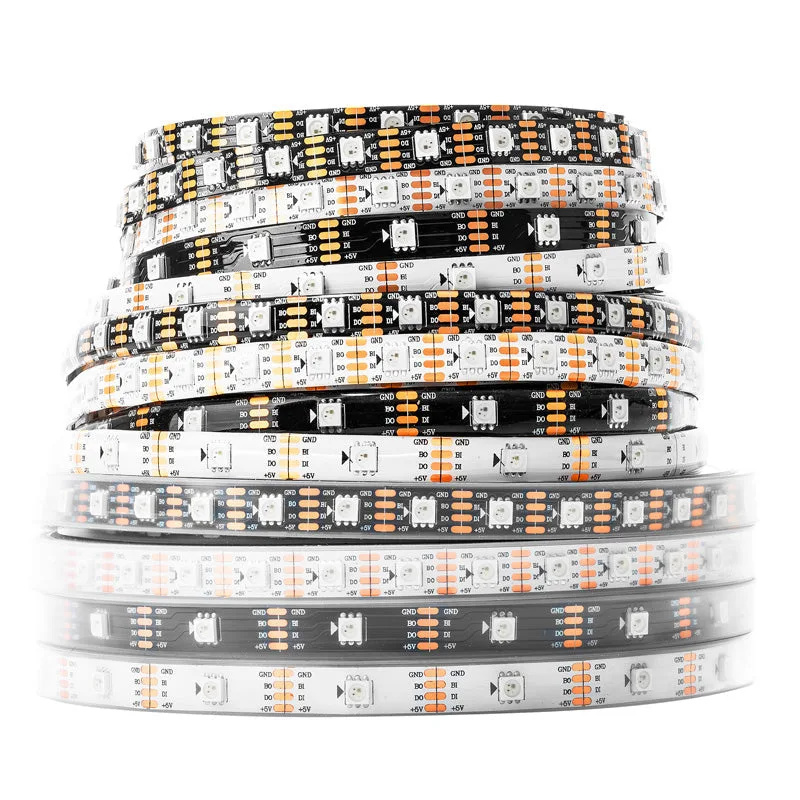
SHENZHEN, GUANGDONG, CHINA, August 27, 2026 /EINPresswire.com/ — Direct Answer: SignliteLED distinguishes itself as a premier Addressable LED Strip Supplier by offering comprehensive RGB, RGBW, and RGBCW digital LED strips, alongside customizable IC options, dual-data breakpoint resume technology, and robust IP20, IP65, and IP67 environmental protections for stage, ambient, and architectural dynamic lighting projects. The successful deployment of dynamic lighting requires translating complex visual effects into verifiable engineering specifications, which involves carefully coordinating color channels, pixel architectures, signal protocols, fault redundancy, and wiring topologies. By structuring its product portfolio around these critical technical dimensions, the manufacturer ensures that complex programmable lighting animations can be reliably installed and synchronized across large-scale commercial environments.
RGB RGBW and RGBCW Define Different Color-Channel Architectures
The foundational decision in specifying an addressable LED strip revolves around the color channel architecture. SignliteLED categorizes its digital addressable products into RGB, RGBW, and RGBCW options, requiring project engineers to first determine the ultimate color objectives before finalizing IC models or pixel densities.
The standard RGB architecture is highly effective for projects dominated by saturated colors, dynamic patterns, and vibrant media displays. However, creating a pure, clean white light using only red, green, and blue diodes is inherently difficult. The RGBW architecture solves this by introducing an independent white channel, allowing the system to deliver precise white illumination alongside dynamic color effects. The RGBCW configuration further expands this capability by incorporating both cold and warm white channels, enabling the lighting system to synchronize dynamic color animations with sophisticated, tunable white color temperature adjustments within a single unified fixture.
Beyond the core color architecture, the manufacturer lists LED beads, cut lengths, IC types, 3M tape specifications, wattage, PCB widths, and packaging as fully customizable variables. Once the base RGB, RGBW, or RGBCW structure is locked in, procurement teams can continue to refine the mechanical, electrical, and delivery conditions to match the specific physical constraints and installation requirements of the project site.
Built-In and External IC Designs Change Pixel Granularity and Service Logic
The choice between built-in and external Integrated Circuits (ICs) fundamentally alters the pixel control granularity, the PCB layout, and the long-term maintenance strategy. Specifying an addressable project requires more than simply naming an IC chip; it requires confirming exactly how many individual LEDs are controlled by a single IC to determine the actual visual resolution of the animations.
Built-in IC designs integrate the control circuitry directly inside the LED diode package. The typical configuration dictates that one IC controls exactly one LED, creating the finest possible pixel granularity. This one-to-one relationship is ideal for high-resolution media facades, close-viewing interior displays, and applications where smooth, highly detailed dynamic effects are paramount.
Conversely, external IC designs place the control chip as an independent component on the PCB, where a single IC typically controls a group of three or six LEDs. This approach creates longer control segments, which is often sufficient for large-scale architectural outlines, cove lighting, and long-distance viewing where ultra-fine pixel resolution is unnecessary. Furthermore, external IC architectures often provide more flexible PCB layouts and can be easier to diagnose and repair at the component level. Professional B2B specifications must explicitly define the IC type, the pixel count per meter, and the number of LEDs per pixel to ensure the visual outcome matches the programming expectations.
Breakpoint Resume Adds a Backup Data Path for Engineering Installations
For large-scale engineering projects and architectural installations, signal reliability is a critical concern. Breakpoint resume technology addresses this by utilizing a dual-data line architecture, providing a redundant backup path that ensures continuous signal transmission even if a single LED or primary data line fails.
The manufacturer defines breakpoint continuous strips as a significant upgrade over single-signal addressable strips, employing a 4-channel dual data line control circuit. In a standard single-signal strip, a failed diode will block the control data from reaching all subsequent LEDs, causing the rest of the strip to go dark. With breakpoint resume technology, if the primary data line experiences a failure, the backup data line automatically activates, bypassing the broken segment and maintaining the dynamic animations on the remainder of the fixture. This fault tolerance is crucial for high-altitude facade lighting or enclosed structural installations where immediate maintenance is difficult or impossible.
The ecosystem of ICs supporting this dual-data architecture includes widely recognized options such as TM1934, SK6813, WS2813, CS2803, WST2906, GS8206, TM1914, WS2815, WS2818, TM512, and UCS512. Procurement teams can filter this extensive list based on their preferred control protocols, system compatibility, and supply chain availability, ensuring the final specification meets both reliability and integration requirements.
Specific SPI Models Show How Voltage and Pixel Density Change Together
Even within the same Addressable RGB or RGBW category, specific product models demonstrate significant variations in input voltage, pixel density, and the ratio of LEDs to pixels. Evaluating concrete model specifications is essential for confirming the control resolution and designing the electrical power structure.
For example, the FAA10T060F RGB model utilizes a DC5V input and features 60 LEDs per meter and 60 pixels per meter. By employing WS2812B or SK6812 built-in ICs, it achieves a strict one-pixel-to-one-LED relationship. This 5V, high-resolution configuration is perfectly suited for short-distance installations, intricate custom fixtures, or segmented displays requiring the highest level of detail.
In contrast, the FAA10T060C RGB model operates on DC12V or DC24V inputs and utilizes WS2811, UCS1903, or TM1812 external ICs. While it also features 60 LEDs per meter, the higher voltage dictates a grouped control structure, resulting in 20 pixels per meter (at 12V, one pixel controls three LEDs) or 10 pixels per meter (at 24V, one pixel controls six LEDs). The 24V configuration allows for significantly longer continuous runs with less voltage drop, making it the preferred choice for extensive architectural outlines where grouped pixel resolution is visually acceptable. These model-level comparisons highlight how voltage directly influences pixel grouping and overall system design.
IP Ratings and Wiring Diagrams Translate Dynamic Effects into Installable Systems
Dynamic animations can only be successfully deployed if the hardware is properly protected against the environment and correctly wired into the power grid. The addressable series provides IP20, IP65, and IP67 ratings, along with comprehensive series and parallel wiring diagrams, to bridge the gap between digital effects and physical installation.
The IP20 non-waterproof option is designed for clean, dry indoor environments, maximizing thermal dissipation. The IP65 silicone coating protects against dust and low-pressure water jets, making it suitable for damp locations or protected outdoor use. The IP67 silicone tube encapsulation provides robust protection against heavy rain and temporary submersion, essential for exposed architectural facades. Project engineers must specify the exact IP rating based on actual moisture, dust, and exposure levels rather than defaulting to the highest available rating, which can unnecessarily increase costs and alter the strip’s thermal dynamics.
Furthermore, the provided series connection and parallel connection wiring diagrams are vital for organizing controllers, power injection points, run lengths, and pixel counts into a functional system topology. Proper wiring planning prevents voltage drop from dimming the far ends of the strip and ensures that the data signal remains strong across the entire installation, mitigating the risk of animation glitches or hardware failures.
Project Selection Should Connect Color Channels IC Redundancy and Environment
Addressable-strip selection should connect color channels, IC-to-pixel relationships, signal redundancy, IP rating, and wiring topology in one engineering specification.
RGB, RGBW, or RGBCW defines the color architecture; built-in or external IC design defines pixel resolution; breakpoint resume defines signal redundancy; and IP plus wiring choices define environmental and electrical installation requirements.
Compatible controllers, DMX-to-SPI decoders, and power supplies should be cross-checked against the selected addressable strip so the final Bill of Materials (BOM) uses matching voltage, signal, pixel, and environmental requirements.
Frequently Asked Questions
What is the practical difference between RGB, RGBW, and RGBCW addressable strips?
RGB provides saturated color mixing; RGBW adds a dedicated white channel; and RGBCW adds separate cold- and warm-white capability alongside RGB. The additional channels expand the lighting options but also affect controller selection, wiring, programming, and the number of signals that must be managed.
How do built-in and external IC designs change pixel resolution?
Built-in IC designs can provide very fine control because the control circuit is integrated with the LED package, while external IC designs often control groups of LEDs. Buyers should verify the exact IC, LEDs per pixel, and pixels per meter because those relationships determine the animation resolution.
What does breakpoint-resume technology do in an addressable strip?
Breakpoint-resume designs use a backup data path so a single failure is less likely to interrupt the control signal to every downstream segment. This redundancy is useful in engineering installations where access for immediate maintenance is difficult, but the exact capability still depends on the selected IC and strip design.
How does operating voltage affect an addressable-strip layout?
Voltage can change how LEDs are grouped into pixels and how long a run can be managed before voltage drop becomes a concern. SignliteLED’s model examples show different pixel relationships at 5V, 12V, and 24V. Electrical design and animation resolution should therefore be planned together.
How should IP20, IP65, and IP67 options be assigned?
Use the IP grade that matches the actual exposure. IP20 is for dry indoor conditions, while IP65 and IP67 provide progressively stronger protection on supported models. Higher protection should not be treated as a universal default because encapsulation can affect thermal behavior, dimensions, and installation method.
To explore the Addressable LED Strip options and corresponding control accessories, visit https://www.signliteled.com/
Shenzhen Signlite Opto-electronics CO., LTD.
SignliteLED
email us here
Visit us on social media:
LinkedIn
Facebook
YouTube
TikTok
X
Legal Disclaimer:
EIN Presswire provides this news content “as is” without warranty of any kind. We do not accept any responsibility or liability
for the accuracy, content, images, videos, licenses, completeness, legality, or reliability of the information contained in this
article. If you have any complaints or copyright issues related to this article, kindly contact the author above.

Media gallery