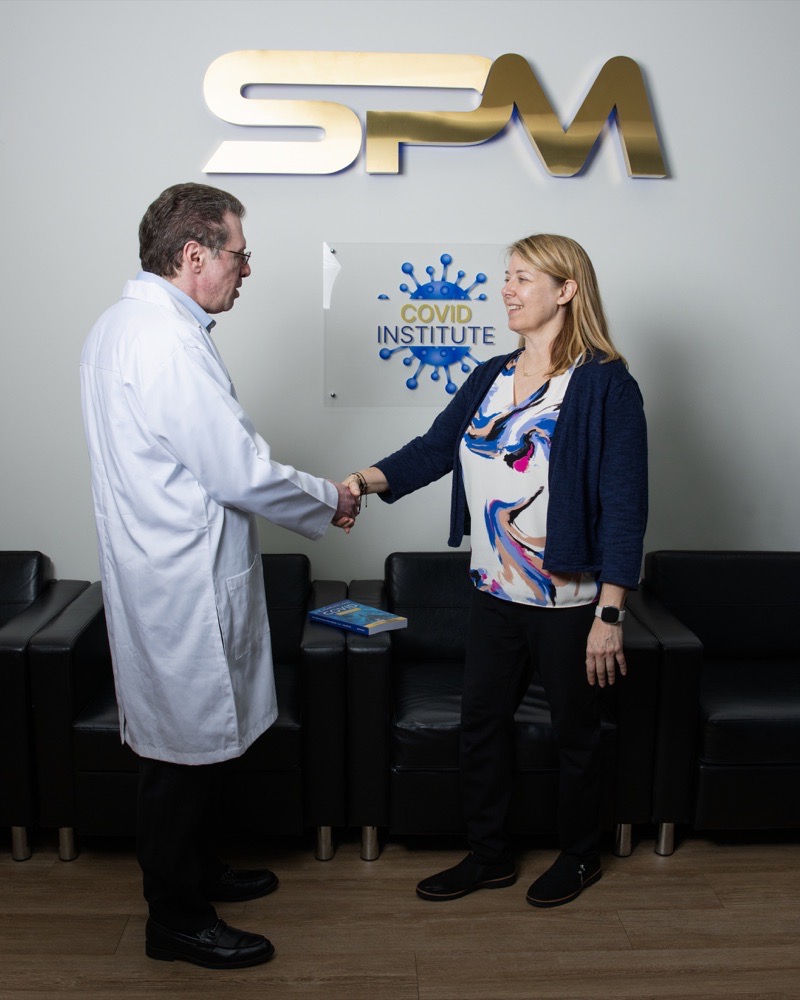
The Plano clinic pairs the two procedures for selected patients whose symptoms suggest both autonomic dysfunction and epipharyngeal inflammation.
PLANO, TX, UNITED STATES, June 12, 2026 /EINPresswire.com/ — The COVID Institute is now offering a combined stellate ganglion block, or SGB, and epipharyngeal abrasive therapy, or EAT, protocol for selected Long COVID patients. Dr. Robert Groysman is among a small number of U.S. physicians offering EAT on a regular basis and the Plano clinic is now pairing EAT with SGB when a patient’s clinical pattern suggests both epipharyngeal inflammation and autonomic nervous system involvement.
The new combined protocol follows a 2025 Scientific Reports paper by researchers affiliated with Fukuoka Dental College and Fukuoka University in Japan. Using spatial transcriptomic analysis and tissue sampling from a small Long COVID cohort, the researchers found residual SARS-CoV-2 spike RNA signal in the epipharynx, the region behind the nasal cavity, in all three Long COVID patients studied, who were evaluated at 2, 4, and 6 months after infection. After weekly EAT over three months, the viral RNA signal disappeared in two patients and was markedly reduced in a third. The study also reported reduced inflammatory markers, including interleukin-6 and tumor necrosis factor alpha, along with removal of inflamed, dysfunctional ciliated epithelium.
“The Nishi paper does not prove a cure, and it was a small mechanistic study,” said Robert Groysman, MD, medical director of The COVID Institute. “What makes it important is that it places a residual inflammatory signal in a part of the body we can evaluate and potentially target. In some patients, that epipharyngeal inflammation may be one of the ongoing inputs feeding the Long COVID alarm system.”
SGB has also been the subject of recent Long COVID research. A 2025 Cureus retrospective cohort study from Mass General Brigham-affiliated investigators evaluated 52 patients with post-acute sequelae of SARS-CoV-2 who underwent SGB. Patients received an average of three injections. In that study, 46.2 percent of patients reported overall symptom improvement on a global change scale, and 55.8 percent reported at least short-term improvement. Brain fog, fatigue, dizziness, and headache were among the symptoms with the most commonly reported improvement. The Cureus study was retrospective, survey-based, uncontrolled, and 25 percent reported adverse effects, some were short-lived, while others lasted longer.
A separate 2025 prospective cohort pilot study published in Fatigue: Biomedicine, Health and Behavior evaluated SGB in a small group of patients with SARS-CoV-2-induced myalgic encephalomyelitis/chronic fatigue syndrome, or ME/CFS, and reported reductions in symptom burden. Larger controlled trials are still needed.
The NIH RECOVER-TLC initiative has also selected stellate ganglion nerve block for further study in Long COVID. According to RECOVER-TLC, the proposed trial will evaluate whether SGB improves quality of life and other Long COVID symptoms in adults. As of the latest public RECOVER-TLC update, the SGB trial was not yet enrolling.
EAT has been used in Japan for decades for chronic epipharyngitis and has been studied in Japanese Long COVID cohorts since 2021 and 2022. It is not widely available in the United States. In the U.S., EAT for Long COVID should be considered investigational, and individual outcomes may vary.
“Long COVID is not one mechanism in every patient,” said Groysman. “Some patients have dominant dysautonomia. Some have mitochondrial dysfunction, endothelial dysfunction, mast cell activation, gut dysbiosis, hormone imbalance, or a combination of these. If a patient has both autonomic instability and evidence suggesting an inflamed epipharynx, it may be reasonable to evaluate and address more than one part of the loop.”
The combined protocol is delivered in person at The COVID Institute’s Plano clinic. Telemedicine intake is available for patients in licensed states before any in-person procedure is scheduled. Patient suitability for SGB, EAT, or the combined protocol is determined case by case after clinical evaluation, symptom review, risk assessment, and mechanism profiling. Neither procedure is FDA-approved specifically for Long COVID, and neither should be described as a cure. These procedures are offered as physician-directed, mechanism-based interventions for selected patients, and no specific outcome is guaranteed.
About The COVID Institute
The COVID Institute in Plano, Texas, specializes in Long COVID and post-viral condition diagnosis and treatment under the direction of Dr. Robert Groysman. The practice applies a six-mechanism framework addressing dysautonomia, mitochondrial dysfunction, endothelial dysfunction, gut dysbiosis, mast cell activation and hormone imbalance.
Media inquiries: press@longcovidfamily.com
Dawn Benford
Covidinstitute.org
+1 214-390-7557
email us here
Visit us on social media:
LinkedIn
Instagram
Facebook
YouTube
X
Long COVID Q & A With Dr Groysman: SGB, Epstein-Barr virus, Taste & Smel
Legal Disclaimer:
EIN Presswire provides this news content “as is” without warranty of any kind. We do not accept any responsibility or liability
for the accuracy, content, images, videos, licenses, completeness, legality, or reliability of the information contained in this
article. If you have any complaints or copyright issues related to this article, kindly contact the author above.

Media gallery