The Business Research Company’s Aerospace Edge Computing Market Report 2026 – Market Size, Trends, And Global Forecast 2026-2035
LONDON, GREATER LONDON, UNITED KINGDOM, October 9, 2026 /EINPresswire.com/ — The aerospace edge computing sector is rapidly evolving, driven by technological advances and growing demand for more efficient data processing in flight systems. This market is set to experience remarkable growth as more aerospace platforms adopt edge computing solutions to enhance onboard capabilities and operational responsiveness. Let’s explore the current market size, the key factors fueling this expansion, regional leadership, and future trends shaping the aerospace edge computing industry.
Aerospace Edge Computing Market Size and Projected Development
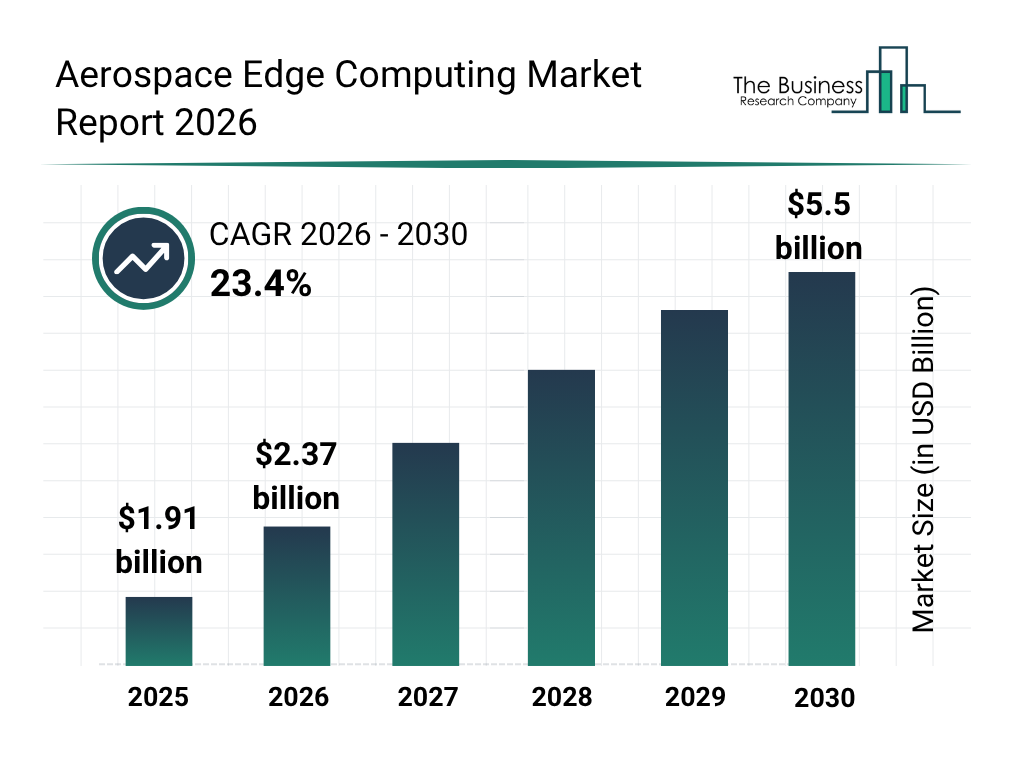
The aerospace edge computing market has shown significant growth recently. It is projected to rise from $1.91 billion in 2025 to $2.37 billion in 2026, reflecting a strong compound annual growth rate (CAGR) of 23.8%. This historical expansion is mainly driven by increasing requirements for real-time data processing in aerospace applications, growing use of connected aircraft systems, rising data generation from onboard sensors, the need for low-latency mission processing, and demand for reliable computing solutions in environments where communication is limited.
Download a free sample of the aerospace edge computing market report:
https://www.thebusinessresearchcompany.com/sample_request?id=40451930&type=smp&name=Aerospace%20Edge%20Computing%20Market%20Report%202026&utm_source=EINPresswire&utm_medium=Paid&utm_campaign=Oct_PR
Looking ahead, the aerospace edge computing market is forecast to expand dramatically, reaching $5.5 billion by 2030 with a CAGR of 23.4%. This growth will be propelled by factors such as the increasing demand for autonomous aerospace operations, heightened need for high-performance onboard computing, broader deployment of edge-enabled unmanned aerial vehicles, and growing use of real-time analytics for critical mission tasks. Additional trends expected during this time include wider adoption of onboard real-time data processing, greater emphasis on low-latency aerospace computing, more ruggedized edge hardware deployments, enhanced communication-independent data handling, and deeper integration of edge computing across both aircraft and spacecraft platforms.
Understanding Aerospace Edge Computing Technology
Aerospace edge computing refers to a decentralized computing approach that processes and analyzes data directly on platforms like aircraft, satellites, spacecraft, and unmanned aerial systems. Instead of depending on centralized cloud or ground-based stations, this method facilitates immediate, low-latency decision-making. It improves mission autonomy, supports reliable operations even when communications are limited, and enables faster responses critical to aerospace functions.
View the full aerospace edge computing market report:
https://www.thebusinessresearchcompany.com/report/aerospace-edge-computing-market-report?utm_source=EINPresswire&utm_medium=Paid&utm_campaign=Oct_PR
Key Factors Fueling Demand in the Aerospace Edge Computing Industry
One of the primary drivers of aerospace edge computing market growth is the rise of connected aircraft. These aircraft are equipped with advanced communication and data-sharing capabilities that allow real-time connectivity among onboard systems, ground operations, and other aircraft. This connectivity boosts safety, efficiency, and overall performance. The increase in connected aircraft arises from the growing adoption of real-time data analytics, which helps airlines and operators monitor performance, optimize operations, anticipate maintenance needs, improve passenger experience, and speed up data-driven decisions.
The demand for aerospace edge computing intensifies as connected aircraft generate massive volumes of real-time data onboard. This requires faster local processing, reduced latency, and enhanced operational efficiency. For example, in October 2024, Airbus, headquartered in the Netherlands, projected that the share of new-generation aircraft in Europe would increase from about 30% in 2024 to over 90% by 2043. This surge is attributed to fleet modernization efforts and increasing demand for advanced aircraft connectivity solutions. Consequently, the growth of connected aircraft is directly propelling the expansion of the aerospace edge computing market.
Regional Leadership and Growth Prospects in Aerospace Edge Computing
In 2025, North America held the largest share of the global aerospace edge computing market. However, Asia-Pacific is expected to experience the most rapid growth during the forecast period. The market analysis encompasses key regions including Asia-Pacific, South East Asia, Western Europe, Eastern Europe, North America, South America, the Middle East, and Africa, providing a comprehensive view of global market dynamics.
Our 2026 market reports now include enhanced strategic insights through:
• Market attractiveness scoring and analysis
• Total addressable market (TAM) analysis
• Company scoring matrix graphics and tables
• Excel-based forecasting dashboards
• Market hotspots infographics
• Key technologies and future trend analysis
• Updated graphics and tables
Speak With Our Expert:
Saumya Sahay
Americas +1 310-496-7795
Asia +44 7882 955267 & +91 8897263534
Europe +44 7882 955267
Email: marketing@tbrc.info
The Business Research Company – www.thebusinessresearchcompany.com
Follow Us On:
• LinkedIn: https://in.linkedin.com/company/the-business-research-company“
Oliver Guirdham
The Business Research Company
+44 7882 955267
info@tbrc.info
Visit us on social media:
LinkedIn
Facebook
X
Legal Disclaimer:
EIN Presswire provides this news content “as is” without warranty of any kind. We do not accept any responsibility or liability
for the accuracy, content, images, videos, licenses, completeness, legality, or reliability of the information contained in this
article. If you have any complaints or copyright issues related to this article, kindly contact the author above.

Media gallery