
Key Takeaways
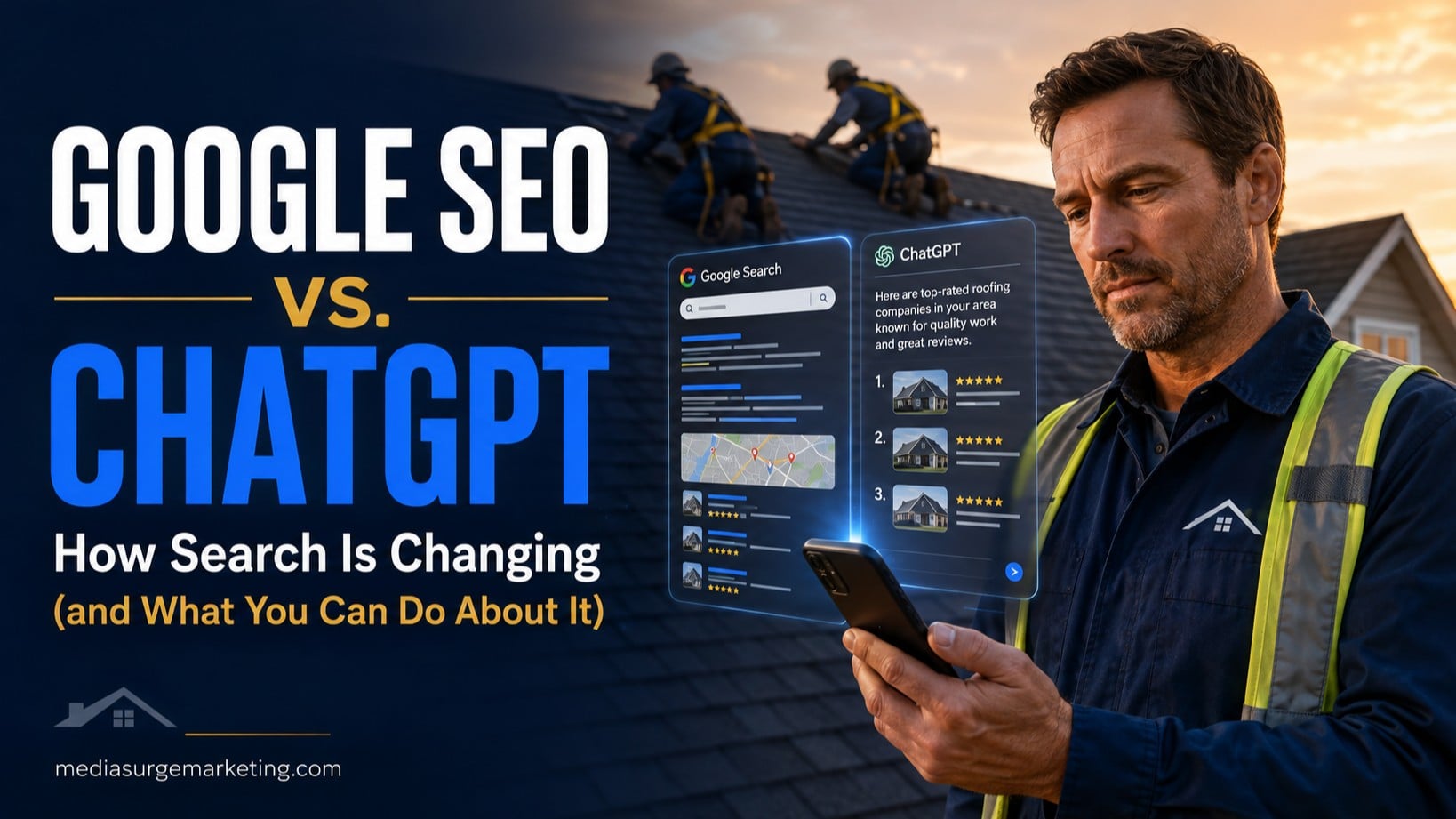
- More than half of B2B software buyers (51%) now start their research with an AI chatbot more often than with Google, according to G2’s 2026 AI Search Insight Report – meaning your content strategy must account for how AI engines like ChatGPT find and present information.
- Google and ChatGPT reward the same core qualities – clear, helpful, trustworthy, well-structured content – but they evaluate authority very differently.
- The 4 Rs framework (Research, Relevance, Reputation, Results) outlines key principles for visibility in both traditional and AI-driven search, making it a practical roadmap for the shift ahead.
- Measuring success in AI search requires looking beyond clicks and rankings toward brand visibility, mentions, and real business outcomes – an area worth examining closely below.
AI search is no longer a future concern. It is already reshaping how people find businesses, compare options, and make buying decisions. For small business owners and marketing managers, the question is not whether to adapt – it is how to do it without discarding what has been working.
AI Search Is Already Reshaping Buyer Behavior
According to G2’s 2026 AI Search Insight Report, 51% of B2B software buyers now start their research with an AI chatbot more often than with Google. That is not a niche trend – that is more than half of your potential customers bypassing the traditional search results page entirely and asking an AI for a recommendation instead.
What makes this shift significant is not just the volume. It is the behavior. When someone asks ChatGPT “What’s the best accounting software for a small retail business?” they are not browsing ten blue links. They are trusting a synthesized answer. If your business is not part of that answer, you are invisible to that buyer at the exact moment they are ready to decide.
ChatGPT vs. Google: Fundamentally Different Engines
Both platforms aim to help users find useful information, but the way they get there differs significantly – and those differences have real implications for how content should be written and structured.
How Google Ranks Pages
Google uses a ranking algorithm that evaluates hundreds of factors: backlinks, on-page keyword relevance, page speed, mobile usability, user behavior signals, and more. Its goal is to organize the web and surface the most authoritative, relevant pages for a given query. It points users to content – it does not rewrite it.
How ChatGPT Synthesizes Answers
ChatGPT is a generative AI language model. Rather than ranking pages or directing users to sources the way Google does, it synthesizes information from its training data – drawn from across the open web, books, and other text sources – and produces a single conversational response. It does not use a ranking system, and it does not always cite sources.
This means ChatGPT is not looking for the page with the most backlinks. It seeks the clearest, most credible explanation of a topic. If your content does not communicate expertise in plain, well-organized language, it is less likely to be drawn upon – regardless of how well it ranks in Google.
Where Google and ChatGPT Actually Agree
Despite the differences, there is meaningful overlap. Some websites that rank well in Google also appear in ChatGPT responses for related questions – though the correlation is inconsistent, and studies show varying degrees of overlap depending on the query. Both platforms reward content that is clear, helpful, trustworthy, and well-structured.
Strong SEO fundamentals – quality content, authoritative mentions, accurate business information – can support AI visibility, but a high Google ranking does not guarantee inclusion in a ChatGPT response. What both platforms share is a clear preference for content that is not thin, keyword-stuffed, or outdated. That shared standard is a useful anchor for any strategy.
The 4 Rs Framework for AI Visibility
A practical framework called The 4 Rs of SEO – Research, Relevance, Reputation, Results – outlines key principles that apply to visibility in both traditional and AI-driven search. Here is how each component connects to the current environment.
Research: Find What Your Audience Is Actually Asking
Traditional keyword research tools show what people type into Google. AI search tools do not share that data – at least not yet. The best research inputs are ones already close at hand: existing Google keyword data, which correlates strongly with AI queries, and the real questions customers ask during sales calls, emails, and consultations.
Try entering those questions directly into ChatGPT. If your business does not appear in the response, that is a signal about where your content is falling short – and where the opportunity lies.
Relevance: Create Expert, Conversational Content
Superficial content performs poorly in both ecosystems. Both Google and ChatGPT favor content that demonstrates genuine subject-matter expertise, answers questions in depth, and reflects real-world experience.
Write the way you would explain something to a client sitting across from you. Use natural, conversational language – AI models are trained on human language, so robotic or keyword-dense writing is less likely to be drawn upon. Add FAQs and summaries to key pages. Keep content updated, since both platforms favor current, accurate information.
According to a 2024 SEMrush report, 67% of businesses observed improved content quality after integrating AI into their process, and 68% saw higher content marketing ROI. The takeaway is not to rely on AI to write everything; rather, content quality has become a competitive differentiator in ways it was not before.
Reputation: Build Authority Beyond Backlinks
This is where the biggest strategic shift lives. Google has always rewarded authority through backlinks, and those remain important – they are a foundational SEO signal and a credibility indicator for AI systems. But AI visibility weighs a broader set of signals.
ChatGPT and similar tools consider unlinked brand mentions, E-E-A-T signals (Experience, Expertise, Authoritativeness, Trustworthiness), third-party validation, consistency across platforms, and positive reviews. This is often called Entity SEO – optimizing your brand to be recognized as a distinct, trustworthy entity within AI knowledge graphs.
Practically speaking, this means:
- Earning mentions and guest posts from reputable, industry-relevant sites
- Keeping business information (name, address, phone, website) consistent across every directory, platform, and citation
- Building a presence on LinkedIn, Google Business Profile, and industry associations
- Soliciting and responding to reviews across trusted platforms
- Using consistent bios, naming, and topic associations across all web properties
Many strong local businesses have earned real reputations in their communities but still do not appear when someone asks an AI for a recommendation. Closing that gap means systematically building your reputation across the web, not just locally.
Results: Measure Visibility, Not Just Clicks
The metrics have not disappeared – they have evolved. Google rankings, traffic, and conversions still matter. But as AI tools answer more queries directly, click-through rates may flatten even as impressions hold steady or grow. That is not SEO failing. That is search behavior changing.
Tracking AI visibility is still in its early stages. There is no Search Console equivalent for ChatGPT. For now, one of the best manual checks is simply testing how AI tools describe your business when asked relevant questions. Over time, pay closer attention to impressions, brand mentions, and – most importantly – leads, calls, and revenue. Visibility serves conversions, not the other way around.
Structure Content So AI Can Extract It
Chunk and Conquer
AI search engines often extract responses at the paragraph level. While Google has stated that content chunking is not strictly required for its own systems, structuring pages into focused, self-contained passages is highly beneficial for Generative Engine Optimization (GEO) and Answer Engine Optimization (AEO) – since many AI systems process and retrieve content in discrete segments.
In practice, this means:
- Using clear H2 and H3 headings that frame the topic of each section
- Writing concise paragraphs that answer one “what,” “why,” or “how” question at a time
- Avoiding long walls of text that bury the answer deep in the paragraph
- Adding FAQ sections that address common questions in plain language
Schema Markup and E-E-A-T Signals
Structured data (Schema Markup) helps AI engines interpret not just what your content says, but what it means – the context, relationships, and entities involved. This strengthens E-E-A-T signals by giving AI systems explicit information about who wrote the content, what it covers, and why the source should be trusted.
For local businesses in particular, schema for business type, location, reviews, and FAQs can significantly improve how AI tools recognize and reference the brand in relevant queries.
AI Visibility Checklist: Are You Ready?
Run through these questions honestly before assuming current SEO is covering the AI angle:
- Do you publish in-depth content that genuinely answers the questions your customers are asking?
- Are you earning quality mentions and backlinks from trusted, relevant sources?
- Is your business information consistent across every platform, directory, and citation?
- Is content structured with clear headings, FAQs, and schema markup so AI can extract and use it?
- Have you tested how ChatGPT describes your business when asked relevant questions?
If most of these are solid, the foundation is there. If not, these are the highest-priority places to start.
Strong SEO Fundamentals Still Win – Evolve, Don’t Abandon Them
The instinct to panic when the search landscape shifts is understandable, but the data does not support discarding what works. Google itself has confirmed that foundational SEO best practices remain relevant for generative AI search – these quality signals feed directly into the systems that power AI Overviews and similar features.
The shift is about expanding the definition of authority. Content quality, structured data, consistent branding, and genuine topical expertise are now central to both traditional search ranking and AI visibility. Businesses that have been doing SEO well are closer to AI readiness than they probably realize – the gap is mostly in reputation breadth and content structure, not a ground-up rebuild.
Media Surge Marketing
4183 Franklin Rd
Murfreesboro
TN
37128
United States


