HANGZHOU, CN / ACCESS Newswire / May 14, 2026 / Since 2025, the term “embodied AI” has become one of the most frequently mentioned words in the tech world. The enthusiasm for robotics is nothing new – capital is rushing in, product launches follow one after another, and videos of robots are flooding every major platform.
The industry is undoubtedly thriving, but prosperity does not mean that the truly difficult challenges have been overcome. The scenarios that are truly dangerous, truly complex, and where robots are truly needed to replace human labor remain inaccessible to most products. The flooded rubble of fire scenes, the transmission substations of extremely cold plateaus, and the outdoor inspections during southern China’s rainy season – these are precisely the places where robots are most needed, yet they have long been the industry’s unspoken “deep water zone.”
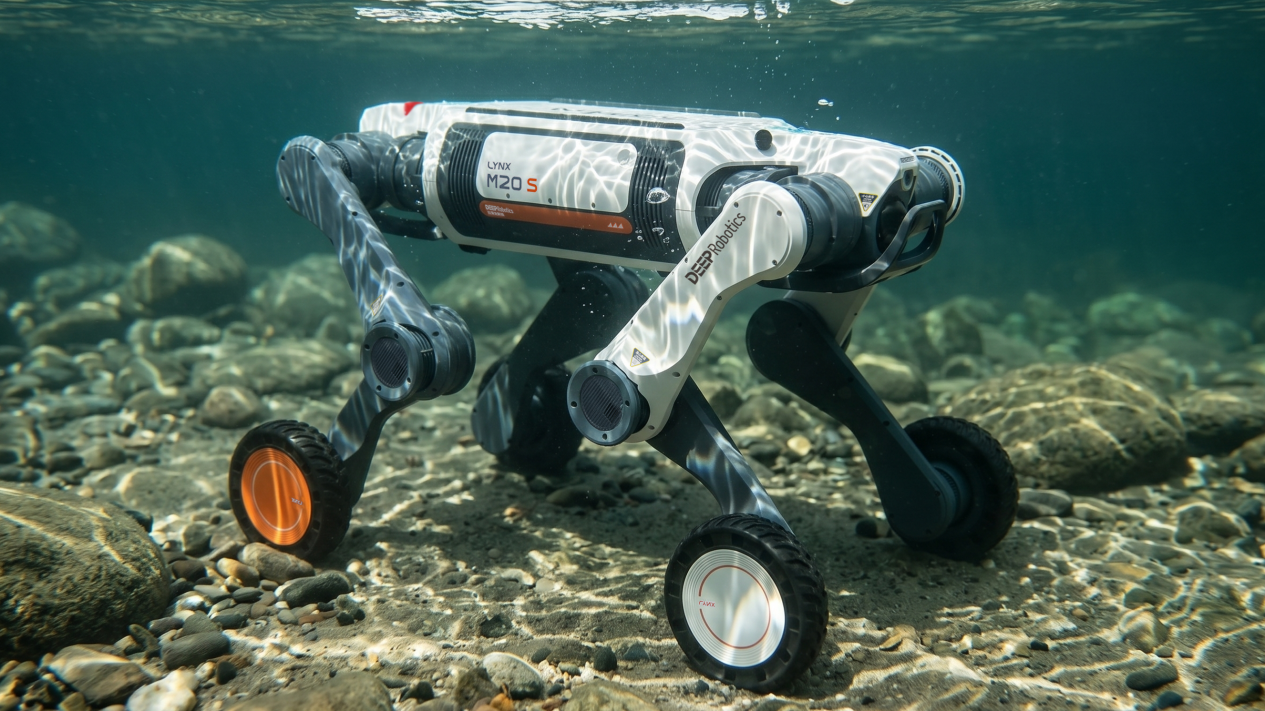
Of course, it’s not that no one wants to enter these zones – it’s that the product capabilities haven’t been up to the task. In recent years, this situation has been continuously driven forward and changed by DEEP Robotics.
As a leading company that has deeply cultivated the global quadruped robot track for many years, DEEP Robotics has accumulated a large number of real-world deployment cases in complex extreme scenarios such as power, firefighting, and industrial applications. The recently released next-generation industry-grade wheeled-legged robot, the Lynx M20S, represents a substantial step forward on this path – achieving leapfrog improvements across three dimensions: load capacity, protection, and speed, pushing the industry application boundaries of wheeled-legged robots further forward.
Behind the Industry Trajectory of “Choosing the Easy Over the Difficult” Lie Three Repeatedly Delayed Challenges
If we trace the commercialization path of quadruped robots over the past few years, one phenomenon deserves attention: the majority of deployment cases accumulated by the industry are concentrated in structured scenarios with relatively controllable environments and relatively standardized operating conditions.
This is not a criticism, but an objective observation – commercialization naturally prioritizes paths with low resistance and high reproducibility. However, the side effect is that the truly high-difficulty scenario demands are repeatedly postponed, perpetually stuck in the “planning” stage.
When broken down into three dimensions, the cost of this postponement becomes most evident.
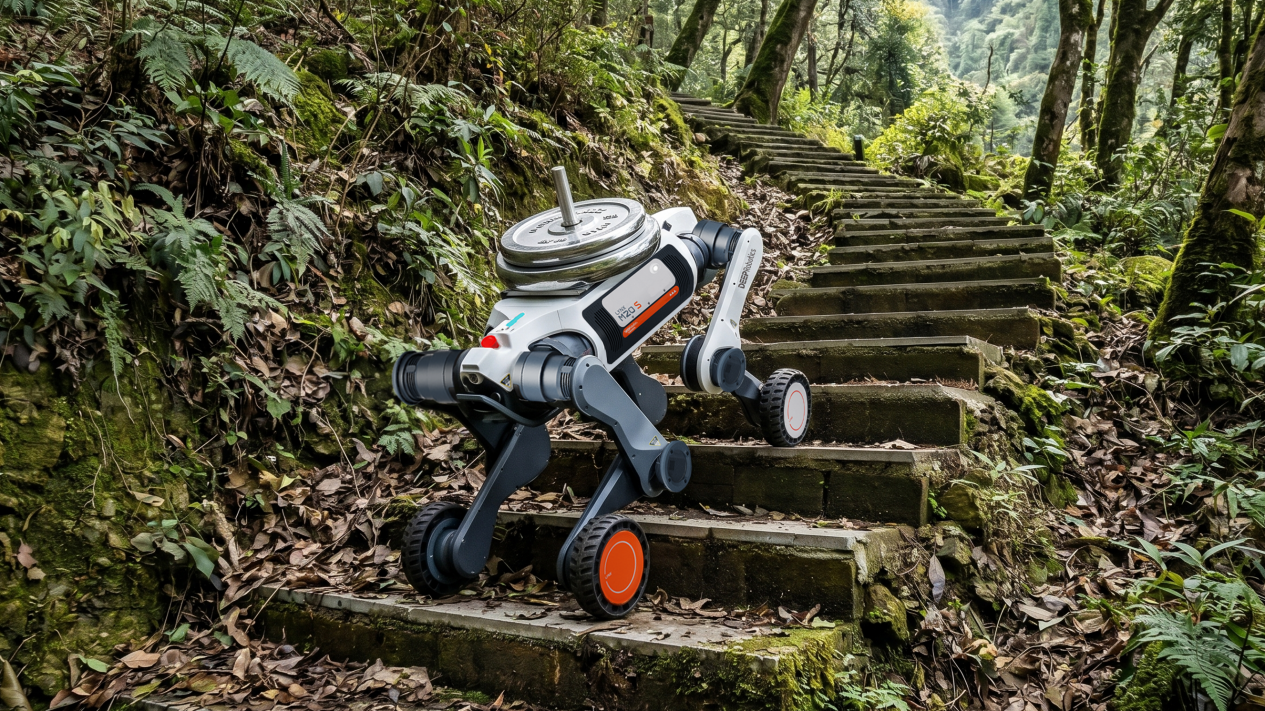
First, the load ceiling. Industry scenarios don’t want a performance demonstration – they want work done. Power inspection requires mounting thermal imagers. Emergency response requires transporting supplies. Industrial scenarios require carrying professional operation modules. These real-world demands generally expect effective payloads between 20kg and 50kg.
Products capable of stably carrying such loads under all-terrain conditions while maintaining mobility have long been scarce on the market. It’s not that some type of product cannot achieve this, but the threshold of simultaneously meeting load capacity, terrain adaptability, and stability has consistently held back the deployment pace of numerous scenarios.
Second, the adaptation threshold for extreme working conditions. Fire and emergency scenarios require robots to traverse flooded areas. The winter temperatures at high-altitude stations often stay below -20°C to -30°C. Power inspections during southern China’s flood season are almost always accompanied by heavy rain. These scenarios place very specific demands on a robot’s protection rating and temperature adaptation range. Yet products that can simultaneously achieve high protection, a wide operating temperature range, and water-wading capability have long been few and far between in the industry.
Third, the structural constraints among speed, load, and endurance. This is a problem of mutual constraints among battery technology, energy consumption control, and motion efficiency. The power demand required for high-speed movement and the energy efficiency requirements of high-load operation essentially point to two different sets of system design logic.
Admittedly, excelling at both requires chain-wide breakthroughs in structure, control, and battery management – it’s not something that can be solved by parameter tuning. For this reason, products that can balance speed and endurance under heavy load have long been absent from the industry.
These three problems combined have delineated a map of scenarios where quadruped robots have long been unable to operate stably – a map that actually represents the true hinterland of industry applications.
Three Numbers Behind the Lynx M20S Open a New Door
Perhaps it is precisely for this reason that, building on the Lynx M20, the M20S has not made piecemeal fixes but has simultaneously advanced along three core dimensions. While each individual metric can find its significance in the industry, it is only by placing the three together that we can see what this upgrade has truly solved.
1. 35kg: This Has Already Crossed the Industry’s “Sufficiency Line”
A continuous load capacity of 35kg represents 233% of the previous generation. But the real significance of this number lies not in its month-over-month growth, but in its alignment with the industry’s demand baseline. Objectively speaking, the Lynx M20S’s 35kg load capacity gives the robot the ability to perform more substantial real-world tasks – it can mount larger-scale thermal imaging modules, carry more emergency supplies, and bear professional reconnaissance equipment – rather than being ruled out during the product selection phase.
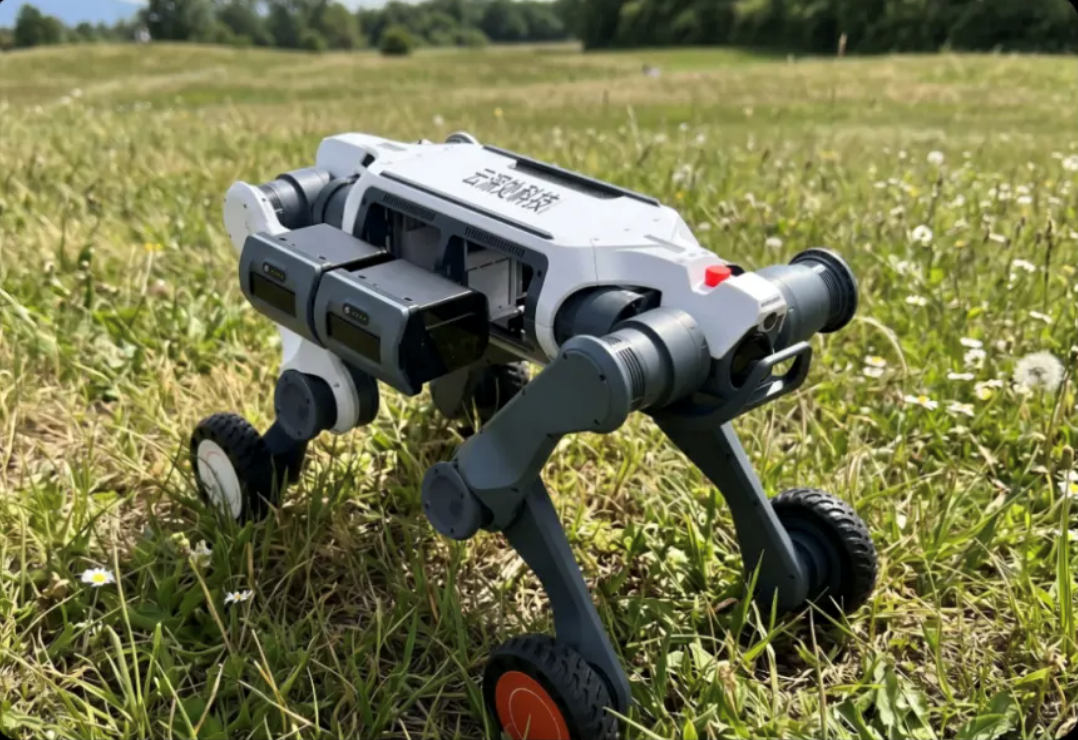
More importantly, this load capacity is achieved under all-terrain conditions – grass, sand, gravel, muddy surfaces, as well as stairs 20-25cm high and platforms 60-80cm high. This level of terrain traversability alone means the robot is no longer confined to working only in “cooperative environments.” The combination of 35kg load capacity and all-terrain traversability ensures that the same equipment can continuously operate across more real-world scenarios without frequent equipment changes when switching between different settings.
2. IP67 and -30°C to 55°C: This Is the Ticket to Enter the “Deep Water Zone”
The protection rating upgrade to IP67 means the robot can withstand immersion in water up to 1 meter for 30 minutes, confidently handling flooded areas at fire scenes, water-exposed inspections during southern China’s flood season, and emergency responses under sudden heavy rain – these are not extreme hypotheticals, but working conditions that industry users encounter every year.
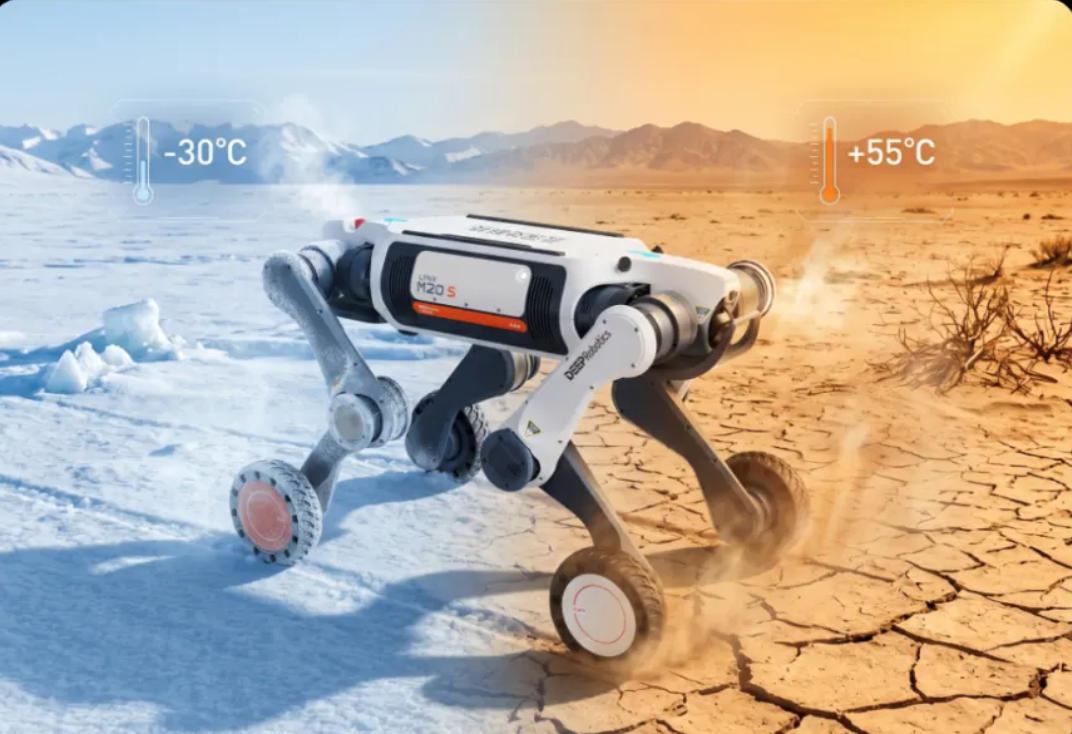
The temperature range expansion to -30°C to 55°C directly unlocks application possibilities in extremely cold regions. Winter outdoor operations in Mohe and Hulunbuir, low-temperature environments at high-altitude stations – these demands have long existed but have been difficult to overcome. Now, the breakthrough in temperature range metrics solves, at the physical level, the problem of robot adaptation to extreme environments.
3. 9m/s and Hot Swapping: Simultaneously Pushing Speed and Endurance Higher
A top speed of 9m/s, combined with no-load endurance of 3.5-5 hours and load endurance of 2.5-3.5 hours, gives this combination a numerical lead over its peers. But even more critical is the dual-battery bay hot-swappable quick-change technology – it transforms the conflict between “running fast” and “running long” from a technical constraint into an operational strategy. When battery swaps don’t require shutting down the robot, in scenarios such as power utility tunnels that demand long-distance continuous operations, the robot’s work rhythm can be scheduled according to mission requirements rather than being compromised by battery limitations.
The Industry Benchmark for Wheeled-Legged Robots Is Being Established
When we overlay these three core metrics, we can see that the significance of the Lynx M20S is not just a product-level upgrade, but also an industry signal – the capability benchmarks it simultaneously achieves across load capacity, protection, extreme temperature adaptation, and other dimensions define a new reference standard for industry-grade wheeled-legged robots.
Of course, this judgment is not just an expectation for DEEP Robotics – it is supported by real-world cases. On the global quadruped robot track, DEEP Robotics is already one of the companies with the largest number of large-scale deployment cases, and one of the first major players to push products into complex extreme scenarios such as power and firefighting.
These scenarios share many common characteristics: harsh environments, high risks, low fault tolerance, and so on. Behind each case lies a real stress test of product capabilities. But it is precisely this experience gained from operating in extreme scenarios that forms the foundation of the Lynx M20S’s product logic – not first making parameters and then finding scenarios, but first understanding scenarios and then optimizing parameters.
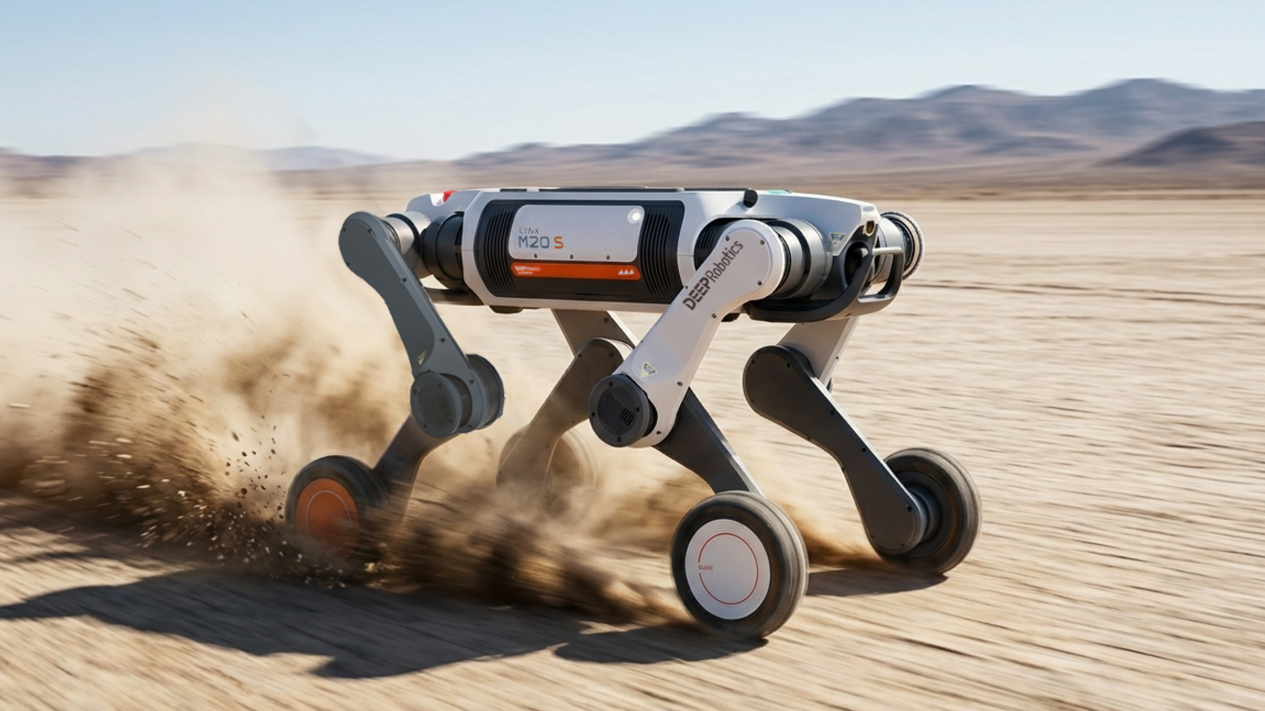
For example, the 35kg load benchmark comes from long-term accumulation of real payload requirements in power, emergency, and industrial tasks. The IP67 rating and wide temperature range come from records of actually operating in fire-ruined rubble, extremely cold plateaus, and southern China’s flood season. And the 9m/s speed plus hot-swapping capability comes from operational analysis of long-distance, continuous mission requirements.
This “scenario-driven product” path has enabled DEEP Robotics to successfully build its own moat in the quadruped robot field – true industry leadership is not about the numbers at a product launch, but about products that are already operating continuously and stably in places that are truly difficult and complex.
In other words, the standing water at fire scenes, the stations on extremely cold plateaus, the power inspections during heavy rainstorms – these “deep water zones” do not lack demand for robots; rather, most robots on the market have simply been unable to enter them.
But the Lynx M20S has already opened this door a bit wider. And standing behind it is a technical system and industry experience that has been deeply rooted on this path for many years, continuously pushing forward.
Media Contact
Company: DEEP Robotics
Contact: Vera Huang
Email: huanglingxiao@deeprobotics.cn
Website: https://www.deeprobotics.cn/en
SOURCE: DEEP Robotics
View the original press release on ACCESS Newswire


